What Is Projectile Motion?
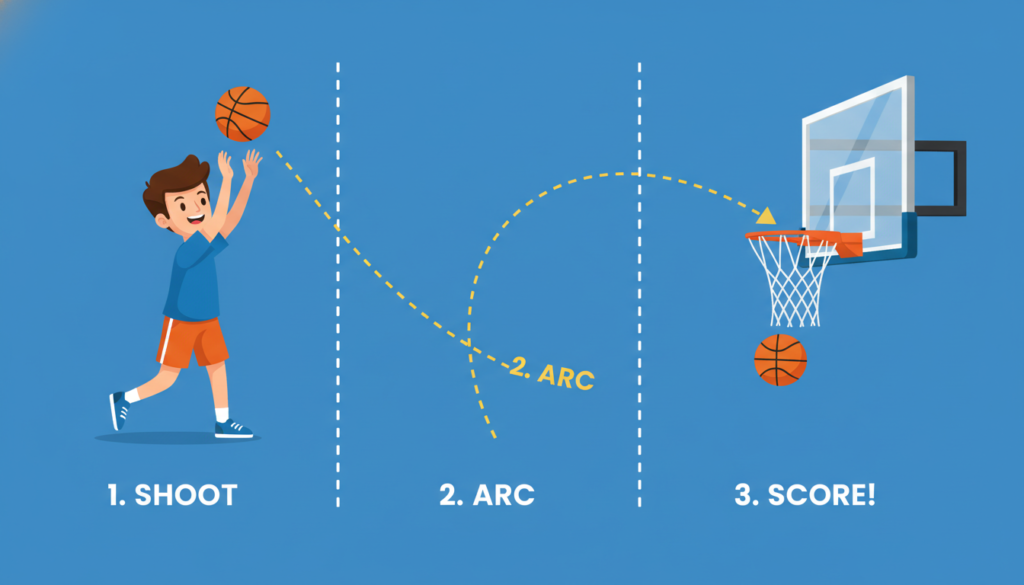
Have you ever thrown a basketball toward a hoop or kicked a soccer ball across a field? If you watch the ball fly through the air, you are watching projectile motion in action. In simple terms, a projectile is any object that is thrown, kicked, or launched into the air. Once it leaves your hand or foot, the only thing pulling on it is gravity.
What Is a Parabola?
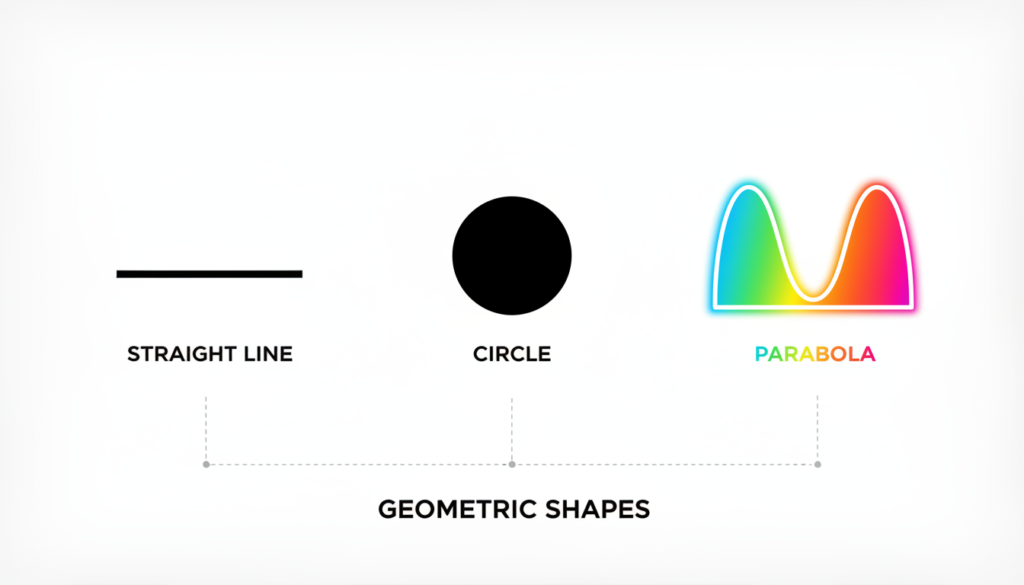
If you trace the path of that flying basketball, you will notice it does not travel in a straight line. Instead, it goes up, reaches a peak, and then curves back down to the ground. In math and science, this beautiful, symmetrical curve is called a parabola.
So, if someone asks you, What Is a Parabola? you can tell them it is the exact U-shaped curve an object makes when it flies through the air under the pull of gravity.
The Physics of Curved Trajectories
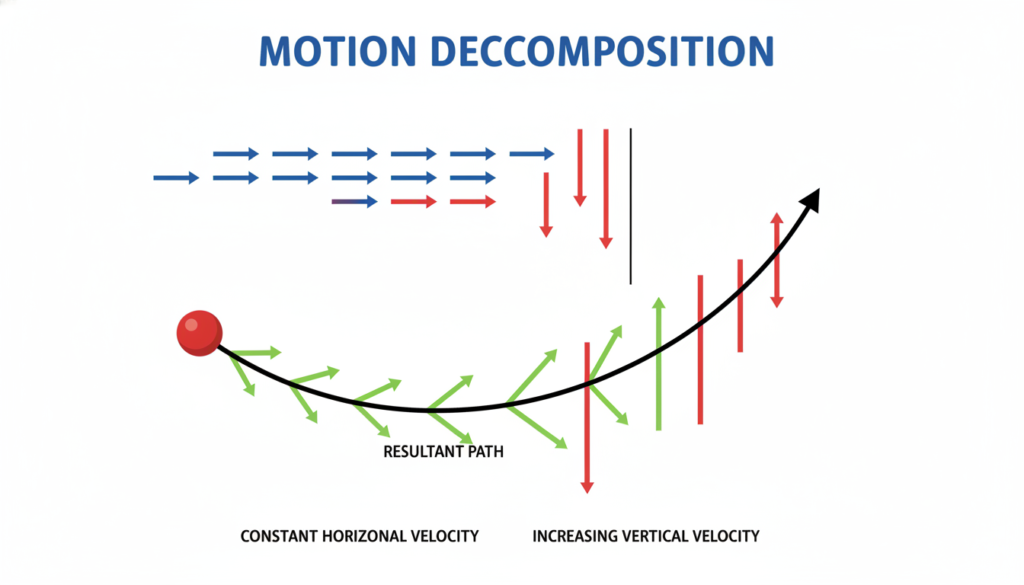
To understand the physics of curved trajectories, we have to look at what happens to the ball the moment it is in the air. It might look like one smooth movement, but it is actually doing two different things at the exact same time!
1. Moving Forward (Horizontal Motion)
When you throw the ball forward, you give it a push. Because there is nothing in the air to stop it (except a tiny bit of air resistance), it keeps moving forward at a steady speed. It does not speed up or slow down in the forward direction.
2. Falling Down (Vertical Motion)
At the same time the ball is moving forward, Earth’s gravity is pulling it down. Gravity is special because it makes things accelerate. This means the longer the ball is in the air, the faster it falls toward the ground.
Why Do These Two Motions Make a Curve?
Imagine walking forward at a steady pace while someone slowly pulls you sideways faster and faster. You would not walk in a straight line; you would walk in a curve!
The same thing happens in projectile motion. The steady forward movement combined with the faster-and-faster downward falling creates a perfect mathematical curve. This combination is the secret recipe for a parabola.
Also read : Does a Rolling Ball Stop Because of Friction or Inertia?
Why Not an Ellipse?
You might wonder why planets and satellites travel in ovals (called ellipses) but a thrown ball travels in a parabola. The answer is distance!
Satellites travel so far that they feel the Earth curving underneath them. Gravity pulls them toward the center of the round Earth. But when you throw a ball in your backyard, the distance is so short that the ground looks completely flat to the ball, and gravity seems to pull straight down. Because gravity pulls straight down on a flat surface, the math works out to be a perfect parabola.
Next time you play catch, watch the ball closely. You are not just playing a game; you are watching the amazing rules of physics in real life!