The short answer
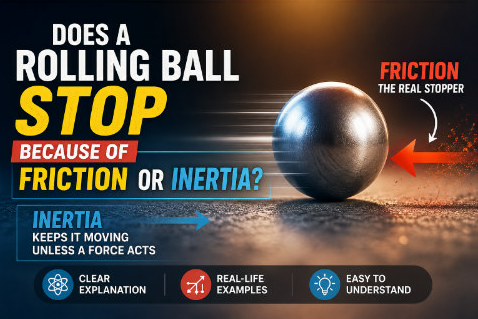
A rolling ball does not stop because of inertia. It stops because of friction. Inertia never slows anything down—it only keeps motion constant when no force is acting. Newton’s first law states: “An object at rest stays at rest, and an object in motion continues in motion with constant velocity unless acted upon by a net external force.” Friction is that external force.
What inertia actually does (and doesn’t do)
Inertia is a property of mass. It resists changes in motion.
- Keeps velocity constant
- Does NOT slow objects
- Does NOT disappear
Where the confusion comes from
In real life, friction is always present. So everything eventually stops. That visible result is often incorrectly attributed to inertia.
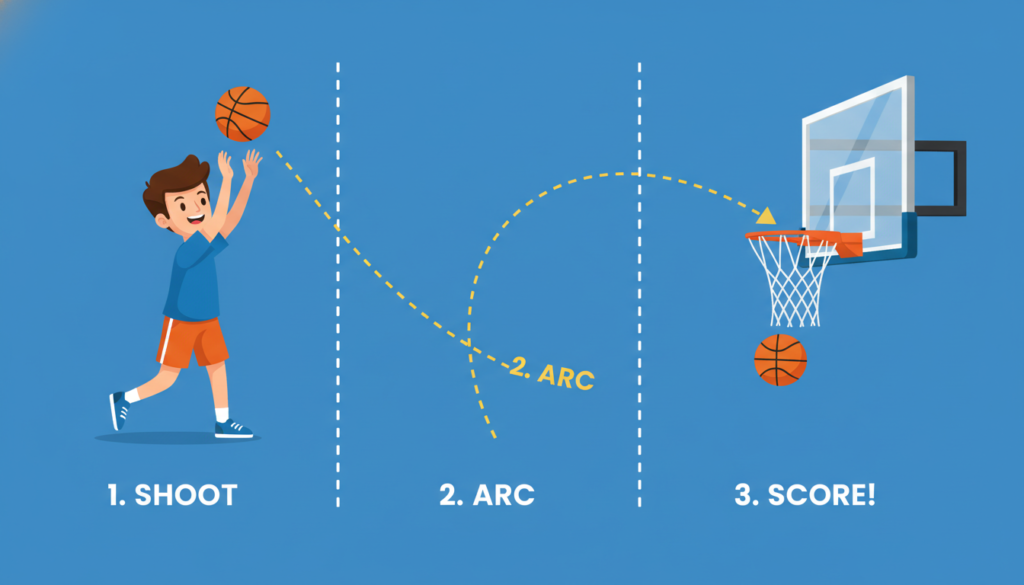
A similar misunderstanding happens in projectile motion. When an object moves forward while falling, two independent motions combine into one curved path. If you want to understand that better, read: Why is projectile motion a parabola? .
The “inertia runs out” myth
Inertia does not decrease. Mass remains constant. What changes is velocity due to friction.
Friction is the real stopper
Fr = μr × N
- Steel on steel ≈ 0.001
- Rubber on concrete ≈ 0.01–0.03
Rolling friction vs sliding friction – they are different
A numbers example so you believe it
Mass = 0.5 kg, Speed = 2 m/s, μr = 0.02
a = 0.02 × 9.8 = 0.196 m/s²
s = v² / (2a) = 4 / 0.392 ≈ 10.2 meters
Common mistakes students and adults make
Mistake #1: Confusing inertia with momentum
Momentum changes with velocity. Inertia depends only on mass.
Mistake #2: Smooth surfaces have zero friction
All real surfaces have friction, even ice.
Mistake #3: The ball “uses up” its motion like fuel
Energy is converted into heat, not consumed.
What happens if you remove friction entirely
Many physics models assume no friction at all. Projectile motion is one of them—where objects move under gravity alone and follow a curved path. Learn more here: Why is projectile motion a parabola? .
Why this matters outside a physics class
- Car braking depends on friction
- Machines reduce friction using bearings
- Spacecraft move freely without resistance
Why do thrown objects follow a curved path?
👉 Read: Why is projectile motion a parabola?
Final breakdown in plain language
A rolling ball stops because friction slows it down. Inertia does not stop motion—it keeps it going unless a force acts.