Table of Contents
Sensex Nifty stock market is having a rough day. Actually, that is putting it mildly. If you looked at your portfolio today, you probably saw a lot of red. The Sensex has taken a significant hit, dropping anywhere from 300 to over 500 points depending on when you checked the ticker, and the Nifty has slipped right below the psychological mark of 26,100. It is not just one sector dragging things down; the selling pressure seems to be coming from multiple directions. When you see the indices tumbling like this, it’s usually a mix of global panic and local profit booking.
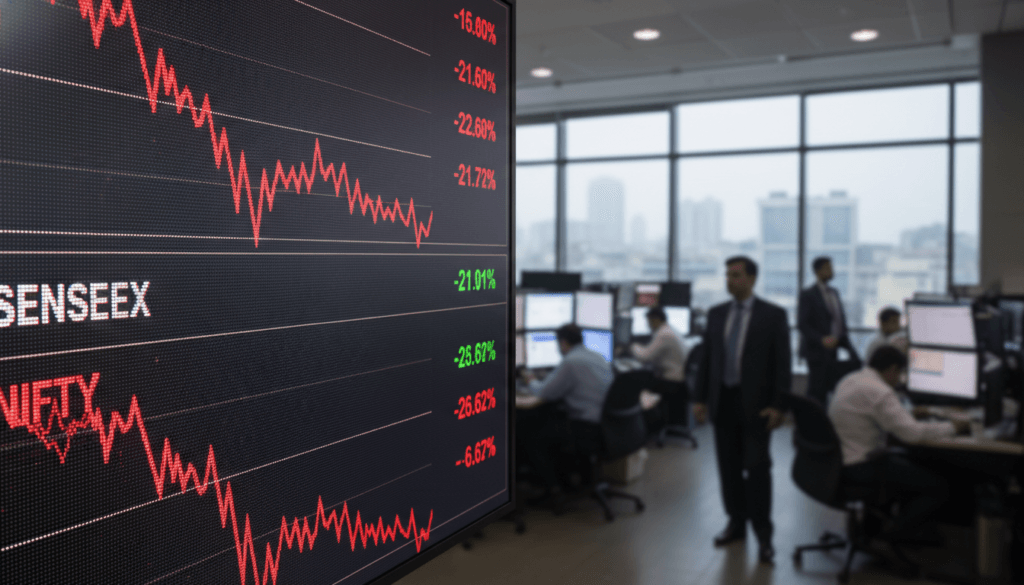
It’s important to understand that this isn’t happening in a vacuum. The numbers are telling a specific story about investor sentiment right now. We are seeing broad-based selling, meaning investors are dumping shares across banking, IT, and other major sectors. Let’s dig into what is actually going on without the jargon.
Sensex slips 300 pts, Nifty below 26,100
The headline numbers are scary for short-term traders. The BSE Sensex, which tracks the top 30 companies, opened weak and just kept sliding. At one point, it was down over 500 points. The Nifty 50, which gives a broader picture of the market health, couldn’t hold its ground above 26,100. When Nifty breaks a support level like that, it often triggers more automated selling, making the drop steeper.
You have to look at the breadth of the market. It’s not just the big giants falling. Mid-cap and small-cap stocks, which have been flying high recently, are also facing the heat. This is what we call a market correction. Prices went up too fast, and now they are adjusting back to reality. The volatility index is likely spiking, which basically measures how nervous investors are. Right now, they are very nervous.
Why are Indian markets falling?
This is the big question everyone is asking. Why now? The market was doing fine, and then suddenly the bears took over. There isn’t one single villain here, but rather a combination of factors hitting at the same time. You have global tension, internal valuation concerns, and big money moving out.
Caution ahead of Fed meet among key factors behind market decline
The United States Federal Reserve is meeting soon, and the entire financial world is holding its breath. This is a massive driver for the drop. When the Fed meets, they decide on interest rates in the US. You might wonder why that matters for a stock trader in Mumbai. Here is the deal: if interest rates in the US stay high, or if the Fed sounds hawkish (meaning they want to keep rates high to fight inflation), safe assets like US Treasury bonds become very attractive.
Investors think, “Why should I risk my money in the Indian stock market when I can get a guaranteed return in US dollars?” So, they pull money out of emerging markets like India. The mere anticipation of this meeting causes caution. Traders don’t want to be holding heavy positions if the Fed delivers bad news, so they sell beforehand. It is classic risk management.
FII selling explained
This leads us directly to the Foreign Institutional Investors, or FIIs. These are the big foreign banks and funds that pour billions into India. Lately, they have been pressing the sell button aggressively. The data shows relentless selling by FIIs over the last few sessions. When they sell, they sell in thousands of crores. Domestic investors (DIIs) try to buy the dip and support the market, but when the FII outflow is this heavy, the market inevitably falls.
Why are they selling? Apart from the Fed jitters mentioned above, they might feel Indian stocks are too expensive. If the Price-to-Earnings (PE) ratios are historically high, foreign investors will book profits and move that capital to cheaper markets, like China or back to the US. It is purely a numbers game for them. They made their profit, and now they are cashing out.
What is Sensex and Nifty in the stock market?
If you are new to this chaos, you might just see these names flashing on the news and wonder what they actually represent. It is simpler than it sounds.
The Sensex (Sensitive Index) is the benchmark index of the Bombay Stock Exchange (BSE). It comprises 30 of the largest and most actively traded stocks on the BSE. These companies are from various sectors and are financially sound. When people say “the market is down,” they usually mean the Sensex is down. It is the oldest index in India.
The Nifty (National Stock Exchange Fifty) is the index for the National Stock Exchange (NSE). As the name suggests, it tracks the top 50 companies. Because it includes more companies than the Sensex, many traders feel it gives a slightly more accurate picture of the overall economy. Both indices usually move in the same direction. If Sensex is down 1%, Nifty will likely be down around 1% too. They are the thermometers of the Indian economy’s health.
Will Sensex touch 1 lakh?
This is the dream target. Everyone talks about Sensex 100,000. Given the current trajectory and the growth of the Indian economy, most analysts believe it is a question of “when,” not “if.” However, days like today remind us that the road to 1 lakh isn’t a straight line. It is going to be bumpy.
To hit 1 lakh, corporate earnings need to keep growing at a healthy pace. Companies need to make more profit. If the economy slows down or if global recessions hit, that target gets pushed further away. While the long-term structural story of India is intact—demographics, consumption, manufacturing—short-term corrections like the one we are seeing today are normal. If you are a long-term investor, you shouldn’t panic about the daily fluctuations. The journey to 1 lakh will have many days where the market drops 500 or 1000 points. That is the price of admission for long-term wealth creation.
Which 5 stocks to buy today?
Okay, I cannot give you specific financial advice because I don’t know your risk appetite, and frankly, catching a falling knife is dangerous. However, when the market bleeds, smart investors look for quality. Instead of giving you a random list, let’s look at the types of stocks that usually survive or bounce back from these corrections.
- Defensive Stocks (FMCG): Companies that sell toothpaste, soap, and biscuits. People buy these things even when the economy is bad. Look at the top FMCG giants; they often fall less than the rest of the market.
- IT Giants with strong order books: While IT can be volatile due to US recession fears, the big players with massive cash reserves are often good value buys when they dip significantly.
- Private Sector Banks: The banking index often takes a beating during FII selling. This sometimes opens up opportunities to buy top-tier private banks at a discount compared to their prices a month ago.
- Pharma: Like FMCG, healthcare is defensive. Sick people need medicine regardless of what the Federal Reserve does.
- Top Gainers of the Day: Even on a red day, some stocks stay green. Check the market reports for stocks that are bucking the trend—sometimes this indicates strong company-specific news that is overpowering the general market negativity.
If you absolutely must buy today, do it in chunks. Don’t put all your money in at once. The market could fall further tomorrow. Buying in a staggered manner helps average out your cost.
To wrap this up, the market is down because big foreign investors are nervous about US interest rates and are taking their profits home. It looks ugly on the screen, but for the Indian stock market, this is just another Tuesday. If you are in it for the long haul, ignore the noise. If you are a trader, keep your stop-losses tight because the volatility isn’t going away anytime soon.
Also read : Powerball Jackpot Hits $930 Million
Also read : CAT 2025 Answer Key Released